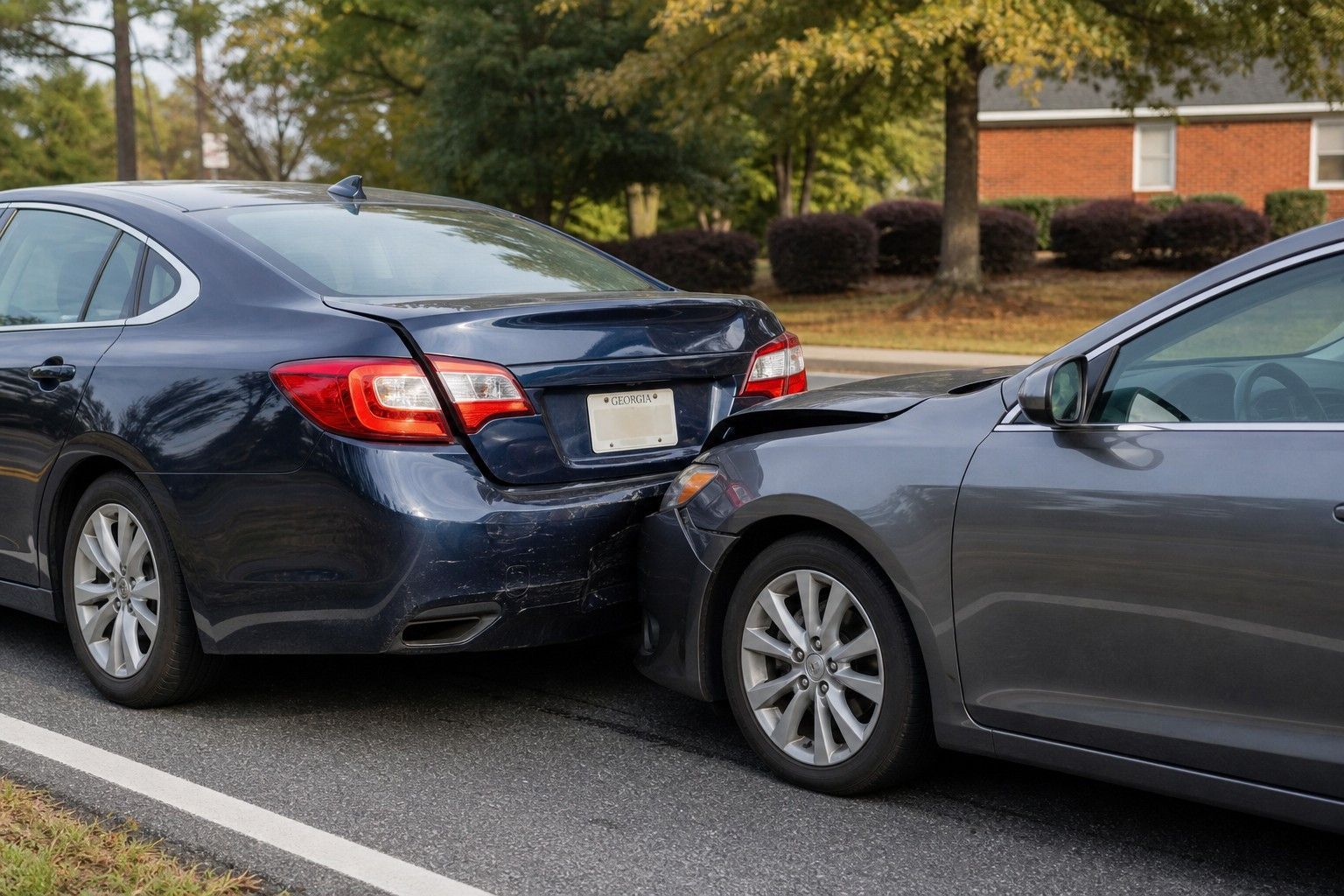
What to Know About Georgia No-Fault Insurance for Car Accidents
Georgia is an at-fault state, not a no-fault state. Here is how car accident claims really work here, and what that means for your money.
Georgia is not a no-fault insurance state. Georgia is an at-fault state, which means the driver who caused the crash, and that driver's auto insurance, pays for the injuries and damage. There is no personal injury protection requirement here. To get paid, you have to prove the other driver was at fault, and you have two years from the crash date to file a lawsuit.
⚡ QUICK SUMMARY
Georgia uses an at-fault (tort) system , not no-fault. Minimum required liability coverage is 25/50/25 : $25,000 per person and $50,000 per crash for bodily injury, plus $25,000 for property damage (Georgia Office of Commissioner of Insurance). Your deadline to sue for injuries is two years under O.C.G.A. § 9-3-33. If you are partly at fault, your recovery drops by your share, and 50 percent or more fault bars recovery entirely under O.C.G.A. § 51-12-33.
If you searched for Georgia no-fault insurance after a wreck in Athens, you probably heard the term from a friend in another state. It matters, because the two systems pay very differently. In a no-fault state, your own policy covers your first medical bills no matter who caused the crash. In Georgia, the at-fault driver's insurance company owes the money, and that company has every reason to argue about who caused it.
Wells and McElwee, P.C. is a personal injury law firm at 700 Oglethorpe Avenue in Athens, Georgia, serving Athens-Clarke County and Northeast Georgia. Our attorneys handle motor vehicle accident claims, including cases where the insurance company disputes fault or the at-fault driver carried too little coverage.
Is Georgia a No-Fault Insurance State?
No. Georgia is a traditional at-fault state for car accident claims. Georgia repealed its no-fault law in 1991, and today no Georgia driver is required to carry personal injury protection. Roughly a dozen states use no-fault or choice no-fault rules. Georgia is not one of them.
That single fact drives everything else about your car accident insurance claim. Fault decides who pays. Evidence decides fault. So the police report, the photos, the witness names, and the medical records you gather in the first week become the backbone of your claim.
Why the label matters
In a no-fault state, an injured driver bills their own insurer first and fault fights come later. In Georgia, there is no such cushion unless you bought optional medical payments coverage. Your bills sit with you until the at-fault insurance company accepts liability or a court decides it.
What Car Insurance Coverage Does Georgia Require?
Georgia requires every registered vehicle to carry liability insurance, and the minimum limits are 25/50/25. That is $25,000 in bodily injury liability per person, $50,000 per incident, and $25,000 in property damage liability per incident, according to the Georgia Office of the Commissioner of Insurance and Safety Fire.
Liability insurance only pays other people. It does nothing for your own injuries or your own car. These optional coverages fill the gaps, and they are the ones people wish they had bought:
Uninsured and Underinsured Motorist
Pays your injury losses when the at-fault driver has no auto insurance policy or limits too low to cover the harm. Georgia insurers must offer it under O.C.G.A. § 33-7-11, and you must reject it in writing.
Medical Payments Coverage
Pays your medical expenses right away, regardless of fault. This is the closest thing Georgia has to the no-fault benefit people expect.
Collision and Comprehensive Coverage
Collision coverage repairs your vehicle after a crash. Comprehensive coverage handles theft, fire, hail, and falling limbs. Both apply before fault is ever settled.
Rental Reimbursement Coverage
Pays for a rental while your car sits in the shop. Without it, you wait on the other insurance company to accept the claim.
Which Insurance Company Pays After a Georgia Car Accident?
The at-fault driver's liability insurance is the primary source of payment for your injuries and vehicle damage. Georgia also lets you file directly against that insurer's insured and negotiate before any lawsuit is filed.
Several policies can be in play at once, and stacking them is often where a claim's real value comes from: the at-fault driver's liability coverage, an employer's commercial policy if that driver was working, your own uninsured motorist coverage, and your medical payments coverage. A careful review of every available auto insurance policy is standard in our car accident claims work.
💡 Pro Tip
Georgia recognizes diminished value claims. Under the Georgia Supreme Court's decision in State Farm v. Mabry (2001), an insurer repairing your car may also owe the lost resale value that repairs cannot restore. Most drivers never ask for it, so most never get it.
Not Sure Which Policy Should Pay Your Bills?
We review every available coverage before you sign anything with an adjuster.
Get Your Free Case ReviewHow Does the Auto Insurance Claim Process Work in Georgia?
The insurance claim process runs in a predictable order, and each step either builds or weakens your case. Insurance adjusters open a file within days and start collecting the version of events that costs their company least.
- Report and document - Call police so a police report exists, then photograph vehicles, road position, and injuries.
- Get medical care right away - Gaps in treatment are the first thing an adjuster uses to argue your injuries came from something else.
- Notify insurers - Tell your own insurer promptly, even when the other driver caused it, so your collision coverage and medical payments coverage stay available.
- Investigation and liability decision - The insurance company reviews the report, the photos, and the repair costs to determine liability and set the actual cash value of your vehicle.
- Demand and negotiation - Once treatment is complete, a demand package with medical records and wage loss goes out, and the negotiating starts.
- Settlement or lawsuit - Most Georgia auto insurance claims settle. If the offer stays unreasonable, filing suit within the two-year window keeps your rights alive.
One caution about recorded statements. The other driver's adjuster may ask for one early. You are not required to give it, and a friendly ten-minute call can produce a sentence used against you months later.
What If the Other Driver Has No Insurance or Too Little?
Your own uninsured and underinsured motorist coverage becomes the payment source. This is common in Georgia, and it is the strongest argument for buying UM coverage rather than waiving it.
18.1%
of Georgia drivers were uninsured, the 7th highest rate in the country
Insurance Research Council data reported by the Insurance Information Institute (2023)
Even insured drivers are often underinsured. A single overnight hospital stay and an orthopedic follow-up can pass $25,000 in medical expenses, which exhausts a minimum-limits bodily injury policy before lost wages are counted. When that happens, your UM coverage and any other applicable policy carry the rest.
How Does Shared Fault Change What You Recover?
Georgia uses modified comparative negligence. Your damages are reduced by your percentage of fault, and if you are 50 percent or more at fault you recover nothing, under O.C.G.A. § 51-12-33.
20% AT FAULT
$80,000
On $100,000 in proven damages, your award drops by your 20 percent share.
50% AT FAULT
$0
At 50 percent or more, Georgia law bars recovery completely.
This is exactly why insurance adjusters push fault percentages onto injured drivers. Shifting you from 30 percent to 50 percent does not trim their exposure, it erases it. Figures above are illustrations of the statute, not a prediction about any case.
How Long Do You Have to File a Georgia Car Accident Claim?
You generally have two years from the crash date to file a personal injury lawsuit in Georgia under O.C.G.A. § 9-3-33, and four years for property damage. Miss the deadline and the claim is gone, no matter how clear the fault was.
Shorter deadlines can apply. Claims involving a city, county, or state vehicle require ante litem notice long before the two-year mark, sometimes within six months. A wrongful death claim has its own timing rules. If a government vehicle was involved, treat the clock as urgent.
Insurers have deadlines too
Under O.C.G.A. § 33-4-6, an insurer that refuses to pay a valid first-party claim in bad faith can owe a penalty plus attorney fees after proper written demand. Documentation is what makes that argument possible.
Local Note: Why Athens Crashes Get Contested
In our Athens practice, disputed liability shows up most in three settings: the Loop 10 merges, the Atlanta Highway corridor, and campus-area intersections where student pedestrian and bicycle traffic mixes with turning cars. In those crashes there is often no clean witness, so the insurance company treats fault as negotiable. Dashcam footage, nearby business cameras, and prompt witness contact frequently settle the question before an adjuster's theory hardens.
We identify every applicable coverage
Liability, uninsured motorist, medical payments, employer policies, and diminished value on the vehicle.
We handle the insurance adjusters
No recorded statements, no early lowball offers presented as final, no paperwork you did not understand.
We build the fault record early
Police report review, scene evidence, and witness statements while the details are still recoverable.
About Wells and McElwee, P.C.
Wells and McElwee, P.C. is a personal injury law firm in Athens, Georgia, representing injured people and their families throughout Athens-Clarke County and Northeast Georgia in motor vehicle, truck, motorcycle, pedestrian, and wrongful death claims. Learn more about our attorneys. This article is general information about Georgia law, not legal advice about your situation.
Talk Through Your Georgia Car Insurance Claim
Schedule Your Free ConsultationNo fees unless we win your case. Call 706-510-2815 or contact us online.